
Ordinary Pet Dogs Become Conservation Heroes, Detecting Invasive Plants with 75% Success

German researchers discover that volunteer dog owners and their pets could help protect biodiversity by finding invasive plants before they spread.
Your dog’s next walk could one day help protect the environment. Researchers in Germany have demonstrated that ordinary pet dogs, trained alongside their owners, can successfully detect invasive plant species in the wild. In a newly published scientific study, volunteer dog-handler teams located approximately 75% of their targets during field tests. The findings suggest that dogs’ remarkable sense of smell could become a valuable tool in protecting biodiversity, while giving ordinary dog owners an opportunity to participate in scientific conservation work. However, the researchers also discovered that enthusiasm alone is not enough: successful conservation dogs need careful training, committed owners and professional guidance.
An Unexpected New Job for Pet Dogs
Dogs already perform an extraordinary variety of jobs, from locating missing people and detecting explosives to identifying diseases and helping wildlife researchers. Now scientists at Germany’s Helmholtz Centre for Environmental Research (UFZ) have investigated whether ordinary companion dogs could help solve another environmental problem: the spread of invasive plants.
Invasive species are organisms introduced into environments where they can cause ecological or economic damage. Some spread rapidly, competing with native plants and changing habitats that other animals depend upon. Finding these species early is particularly important because controlling a small population is usually easier and less expensive than dealing with an established invasion.
Unfortunately, invasive plants are not always easy to locate. They may grow among dense vegetation, remain hidden beneath other plants or be difficult to recognise during certain stages of development. Human survey teams must often search large areas, making monitoring expensive and time-consuming. Dogs, however, can detect characteristic odours even when the source is difficult to see.
The German researchers wanted to discover whether this ability could be developed in privately owned dogs rather than relying entirely on specialised professional detection teams.
Training Dogs to Find Three Invasive Plants
Between 2021 and 2023, researchers recruited 31 dogs and their owners for a volunteer training programme. The participants learned to recognise the scents of three invasive plant groups: Japanese knotweed and related species (Fallopia), Himalayan balsam (Impatiens glandulifera) and common ragweed (Ambrosia artemisiifolia).
These plants were selected because of their widespread occurrence and their effects on biodiversity, agriculture, infrastructure or human health. Ragweed, for example, produces pollen that can trigger serious allergic reactions, while knotweed can form dense stands that displace native vegetation.
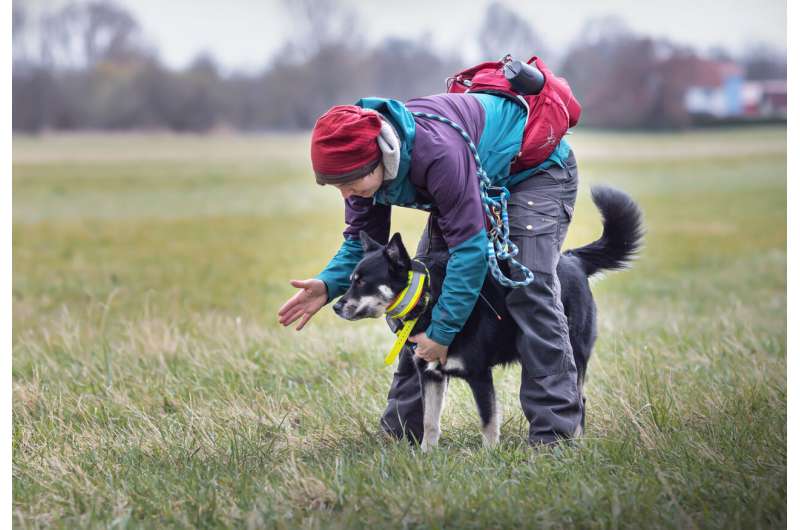
Training combined online lessons, practical seminars and outdoor exercises. Owners learned how to introduce their dogs to plant scents, reward successful searches and recognise the behaviour indicating that a target had been found. Researchers also examined how different training methods, rewards and environmental conditions influenced performance.
The process was demanding. Although 87.1% of participants completed the online training and 77.4% attended the practical seminar, only 12 teams eventually conducted the final field test. This difference became one of the study’s most important findings: developing reliable volunteer detection teams requires considerable time and commitment.
Impressive Results in Real-World Searches
The dogs that reached the final stage performed remarkably well. Of the 12 teams participating in field tests, 11 passed the assessment. On average, they detected approximately 75% of the target plants, demonstrating that trained companion dogs could successfully transfer their skills from training exercises to outdoor searches.
The researchers also discovered that training details mattered. Dogs performed better when they had been introduced to different parts of the target plants rather than learning only one type of sample. Larger plant pieces were generally easier to detect during practical exercises.
Another challenge involved transferring learned scent recognition to unfamiliar conditions. When dogs trained with previously frozen plant material encountered fresh samples, spontaneous recognition occurred in only 56% of cases. This suggests that training must include enough variety to prepare dogs for the different conditions they will encounter outdoors.
Interestingly, the teams with the strongest training results were not necessarily those most likely to complete the programme. Personal motivation and the ability to continue participating appeared especially important. The findings suggest that selecting committed volunteers may be just as important as identifying dogs with promising scent-detection abilities. UFZ
Could Everyday Dog Walks Help Protect Nature?
The researchers believe volunteer detection dogs could eventually become a useful addition to existing environmental monitoring programmes. Their greatest potential may lie in early detection, when invasive plants are still relatively uncommon and difficult for human observers to locate.
For conservation organisations, working with trained volunteers could make it possible to survey more locations without maintaining large numbers of professional detection dogs. For owners, the activity could provide mental stimulation for their pets while allowing them to contribute directly to environmental protection.
However, the study does not suggest that any dog owner can immediately begin identifying invasive plants. Reliable detection requires structured training, continued practice and cooperation with ecological specialists. Incorrect identifications could waste resources, while missed plants might allow an invasion to continue spreading.
The study also involved a relatively small number of successful field teams. Larger investigations will be needed to establish how well volunteer programmes perform over longer periods and across different landscapes.
A Promising Partnership Between Dogs and Conservationists
The German project illustrates how an ability dogs already possess could be developed into a practical conservation tool. Their extraordinary sense of smell, combined with the enthusiasm of dedicated owners, may help scientists discover invasive plants that would otherwise remain unnoticed.
The research also highlights an important lesson about citizen science. Volunteers can make meaningful contributions to professional research, but successful programmes need careful organisation, training and continued support.
For now, the findings offer an encouraging possibility: the familiar activity of walking a dog could eventually become part of a much larger effort to protect natural habitats.
And for dogs that enjoy searching and using their noses, helping to protect biodiversity might become one of the most rewarding jobs imaginable.
Primary Sources
1. Original peer-reviewed scientific paper
Grimm-Seyfarth, A., Harms, W., Koch, V. P., Haack, N., Harpke, A., Krauss, K., and Berger, A. (2026).
Opportunities and challenges in training volunteer wildlife detection dog-handler teams for invasive plant monitoring.
PLOS One, 21(11), e0359003.
Published: 4 November 2026.
DOI: 10.1371/journal.pone.0359003.
Read the original open-access scientific paper
The publisher’s full-text page was temporarily inaccessible during verification. However, the paper’s abstract, authorship, findings and publication details were independently confirmed through the research institution’s official publication database. UFZ
2. Official research institutionHelmholtz Centre for Environmental Research
UFZ official publication record
The institutional record confirms the research methods, participating teams, completion rates and field-test results.
3. Original publisher research announcement
PLOS research announcement — 4 November 2026
The announcement provides additional explanations from the research team about volunteer participation, training requirements and the potential conservation benefits.