
What Does Your Face Tell Your Dog? New Study Reveals Surprising Differences in Human Expressions

When people talk to their dogs, they often change their voices, exaggerate their expressions and smile in ways they might not use during an ordinary conversation. But new research from Hungary suggests that these facial signals are more complicated than previously thought. Scientists studying 146 adults discovered that people’s body condition was associated with differences in the facial expressions they displayed when communicating with dogs. Published on 28 October 2026, the findings offer a new perspective on the subtle signals involved in human–dog relationships, although they do not establish whether dogs actually respond differently to those expressions.
Communication Is More Than Words
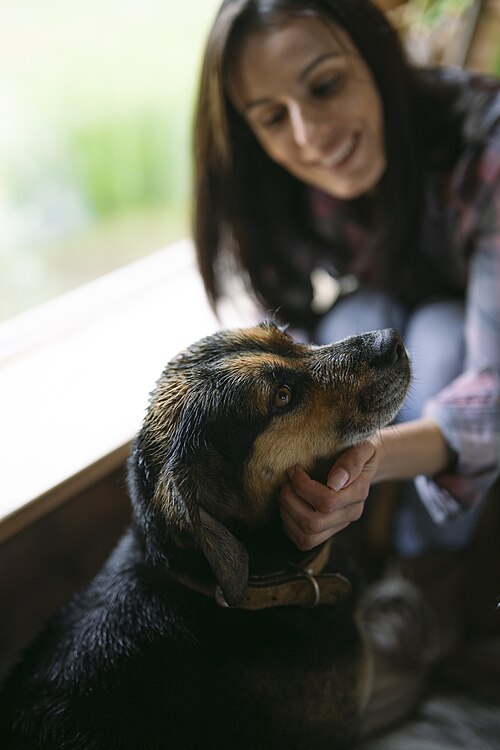
Most dog owners recognise the special voice they use when speaking to their pets.Questions such as “Who’s a good dog?” are often delivered with a higher pitch, exaggerated intonation and an enthusiastic expression.Scientists call the rhythm, pitch and emotional qualities of speech prosody.
However, communication also involves facial movements accompanying spoken words. Researchers refer to these movements as visual prosody.Previous studies have shown that people use distinctive facial expressions when talking to dogs, much as they do when communicating with babies.
Dogs are particularly sensitive to human social signals. They can follow pointing gestures, respond to facial expressions and use information from people’s behaviour when making decisions.Understanding how owners communicate visually may therefore provide important clues about the relationship between humans and dogs.
Researchers Examine 146 Adults
The new investigation was conducted by scientists from the HUN-REN Research Centre for Natural Sciences, Eötvös Loránd University and collaborating institutions.The researchers analysed existing video recordings involving 146 adult participants, including 95 women and 51 men.
Participants had previously been recorded while interacting with their own dogs, their babies or other adults.The conversations took place in homes or laboratory settings and involved ordinary activities such as playing games, teaching simple tasks or speaking naturally to another individual.
The researchers used specialised facial-analysis software called FaceReader to examine the recordings.The software measured several characteristics, including expressions classified as happiness, facial activity, emotional positivity and movements of the muscles involved in smiling.Two recordings could not be analysed successfully, leaving usable facial measurements from 144 participants. frontiersin.org
An Unexpected Difference in Facial Expressions
The researchers were particularly interested in whether body condition was associated with differences in facial communication.Participants were divided into two broad categories based on their apparent body condition: normal weight and overweight.The analysis revealed several interesting patterns.
People in the higher body-condition category generally displayed lower levels of facial activity across communication situations.However, differences in expressions classified as happiness were particularly noticeable when participants were talking to dogs.In that situation, the facial-analysis software recorded less intense happy expressions and lower emotional positivity among participants in the higher body-condition category.The same pattern was not observed when participants spoke to babies or other adults.
This suggests that differences in facial expression may depend partly on whom a person is addressing.Importantly, the findings concern measured facial movements, not how much affection participants felt for their dogs.
Does This Mean Some Owners Love Their Dogs Less?
Absolutely not.The researchers did not measure affection, emotional attachment or the quality of relationships between owners and their dogs.Instead, they examined visible facial movements using computer software.Several explanations could account for the results.
Differences in facial anatomy might influence how expressions appear to the software. The researchers also considered whether the software’s ability to recognise expressions varied between different facial shapes.Another possibility is that people naturally develop different communication styles.
The findings therefore cannot establish that participants in one body-condition category were happier, friendlier or more affectionate than those in another.Nor do they demonstrate that dogs preferred one type of facial expression.
Women and Men Also Communicated Differently
The researchers identified another pattern involving gender.Female participants generally displayed more intense positive facial expressions and greater facial activity than male participants.However, these differences became smaller when people were communicating with dogs.This finding suggests that dog-directed communication may share certain characteristics across different groups of people.
The researchers note that previous studies have also identified distinctive features in the way humans communicate with companion animals.Nevertheless, individual differences remain considerable, and the results should not be used to predict how any particular person communicates with their dog.
Important Limitations
The study has several limitations.The recordings were originally collected for other research projects, and not every participant completed all three communication situations.Body condition was estimated from video recordings rather than measured through direct medical assessment.
The researchers also relied on automated facial-recognition software, which may interpret facial movements differently depending on individual anatomy.Most importantly, the study did not measure the dogs’ responses.It therefore remains unknown whether the observed differences influenced canine attention, understanding or behaviour. frontiersin.org
What Can Dog Owners Learn?
The research does not suggest that owners should deliberately change their facial expressions.Instead, it highlights how complex communication between humans and dogs can be.Dogs receive information through words, tone of voice, gestures, facial expressions and the circumstances surrounding an interaction.
These signals work together rather than independently.Future research could investigate whether dogs respond differently to particular facial movements and whether individual communication styles influence training or emotional relationships.For now, the study offers a fascinating reminder that everyday conversations with dogs involve far more information than we might realise.
The next time you speak to your dog, consider what your face is communicating alongside your words.Your dog may be paying attention to both.
Primary Scientific Source
Original peer-reviewed research — Published 28 October 2026
Gergely, A., Filep, L. A., Kukovič, T., & Kis, A. (2026).
Body condition-linked alterations in dog owners’ visual prosody.
Frontiers in Veterinary Science, Volume 13, Article 1962197.
DOI: 10.3389/fvets.2026.1962197
Read the complete original scientific paper
The article is open access under Creative Commons Attribution 4.0 and includes the research methods, statistical analyses, figures and discussion of limitations.
Scientific assessment: The investigation analysed facial movements in recordings from 146 adults, with usable measurements from 144. Its findings demonstrate associations between estimated body condition and particular facial-expression measurements. They do not establish causation, differences in affection or effects on canine behaviour. frontiersin.org