
Can an Electronic Nose Help Police Dogs Find Missing People? Australian Study Offers Clues

Australian scientists have tested whether an electronic “nose” can help police understand what trained dogs detect when searching for human remains. In a newly published study, three police dogs searched a simulated burial site while a portable sensor measured chemicals released into the air. The early results suggest the technology could support training and help investigators interpret dogs’ alerts. But the researchers are clear: the machine is not ready to replace a dog’s remarkable sense of smell.
Why a Dog’s Nose Is So Hard to Match
When a person disappears, specialist dogs may be called in to search woods, fields or other difficult ground. Human-remains detection dogs are trained to recognise odours associated with decomposition and alert their handlers when they find a possible source. The challenge is that these odours are not fixed. As remains break down, different chemicals are released, and their amounts change with time, temperature, rain and soil conditions. A dog searching months after a burial may encounter a very different scent from one working shortly after a death.
For trainers, an important question remains unanswered: which chemicals actually cause a dog to alert? Researchers at the University of Technology Sydney believe a portable sensor might help investigate that question.
A Grave in Western Sydney
The study, published on 21 October 2026 in the peer-reviewed journal PLOS One, used a controlled research site in western Sydney. The experiment itself took place in 2020, using the body of a person who had donated their remains to science.The remains were buried about 60 centimetres below ground. The researchers waited 98 days before beginning their searches, creating conditions similar to an investigation involving someone missing for several months.
The team returned on six occasions between 98 and 161 days after burial. They also prepared empty control graves to help distinguish decomposition odours from other smells in the environment.
Three Dogs, One Electronic Nose
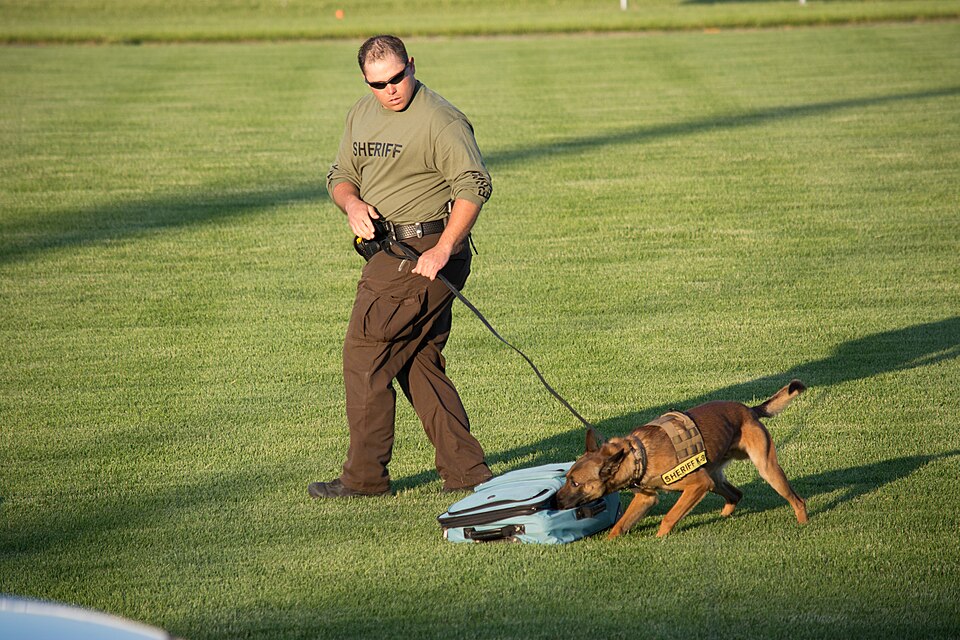
Three certified New South Wales police dogs took part. The researchers thanked Wags, Tilly and Bryson by name in the published paper, alongside their handlers.Each dog searched independently, approaching the area from different directions. Their handlers watched for trained signals such as lying down or barking. The team also tested a device called NOS.E, fitted with five chemical sensors.Unlike a dog’s nose, the device does not identify an individual scent as a living animal might. Its sensors respond to groups of airborne chemicals, including alcohols, hydrocarbons, and compounds containing sulfur or nitrogen.
Laboratory tests of air samples helped researchers check which chemicals were present. That gave them a way to compare the dogs’ behaviour with measurable changes in the air.
What the Researchers Found
Both the dogs and the electronic nose responded to the burial site. The researchers noticed that stronger sensor readings often appeared alongside correct alerts from the dogs, particularly when certain sulfur- and nitrogen-containing compounds were more abundant.The most experienced dog did not produce a false-positive alert during the recorded trials. Other dogs sometimes alerted incorrectly or failed to alert when the ground had not been disturbed.
One important detail was the effect of probing the soil. Small openings released trapped odours, making the burial easier for the sensors to detect. After probing, the dogs also gave more reliable alerts in this particular experiment.This does not mean investigators should disturb a suspected grave before searching. The experiment was conducted under controlled research conditions, and the findings are not a new police operating procedure.
Promising Results, but Not Proof
The strongest caution comes from the statistical analysis. Although the researchers observed patterns linking dog alerts with sensor readings, those associations were not statistically significant after adjustment for multiple comparisons.The study also involved only one donated body and three dogs. The dogs had different levels of experience, and repeated visits could have made the location increasingly familiar. Soil, weather and burial depth might produce different results elsewhere.These limitations mean the study cannot establish how accurately an electronic nose would work across real investigations. It also cannot tell scientists exactly which molecules dogs recognise.
A Partner for Working Dogs
Even so, the researchers see a practical opportunity. If trainers can measure whether decomposition-related chemicals are present, they may be better able to understand why a dog alerted—or why it did not. Such measurements could eventually improve training exercises, especially for younger dogs learning to distinguish a genuine target from misleading cues. The technology might also have uses in dangerous environments where sending dogs or people into an area would be unsafe, although that was not tested here.
The research team now hopes to study more donated bodies, more dogs and repeated visits under tighter controls.For the moment, the message is not that machines are catching up with police dogs. It is that a machine may help people understand the extraordinary work those dogs already do.
Primary Scientific Sources
1. Original peer-reviewed research — 21 October 2026
Brown, A. O., Alahakone, S., Lamb, E., Pasin, D., Hawker, D., Liu, T., et al. (2026).
A case study comparing the detection ability of cadaver detection dogs and electronic nose technology to a clandestine grave.
PLOS One, 21(10), e0360233.
DOI: 10.1371/journal.pone.0360233
Read the complete original scientific paper
The paper is open access under Creative Commons Attribution 4.0.
2. University of Technology Sydney — Official Research Announcement
Published 22 October 2026.
Electronic nose puts police detection dogs to the test
This announcement includes explanations from lead researcher Amber Brown and Associate Professor Maiken Ueland, director of the Australian Facility for Taphonomic Experimental Research.
3. Original Research Data
The researchers have also made the electronic-nose data and associated computer code publicly available.